Why AI Budgets Break: Managing the 75% of AI Cost That Isn't Tokens
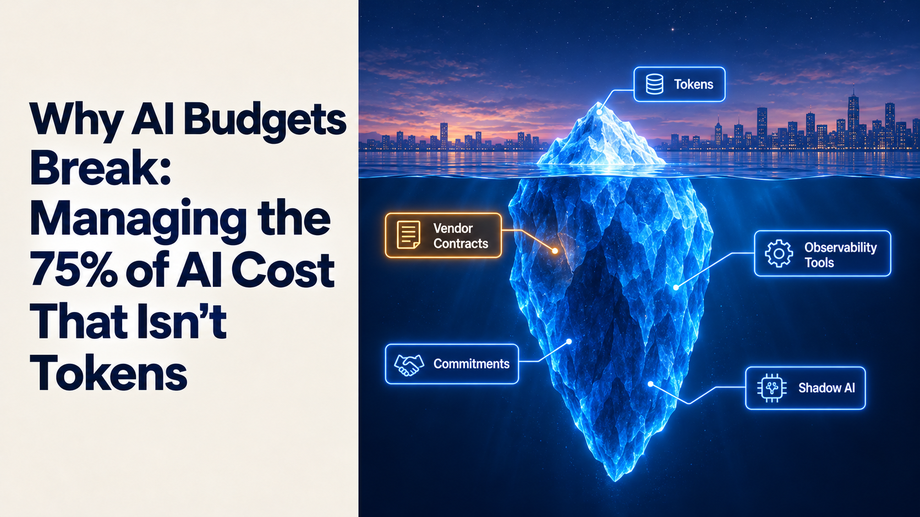
Most AI budgets are built around one number: what the model costs per million tokens. It's the most visible line on the bill, it's easy to meter, and every provider publishes it. According to the FinOps Foundation, it's also the smallest part of the picture.
In its October analysis of AI spend budget busters, the FinOps Foundation points to the Total Cost of AI (TCA) framework, which holds that token and API costs make up only 10–25% of total AI spend once energy, capital, infrastructure, software, labor, and process costs are counted. A budget that only prices the model is pricing a fraction of the real bill.
The results show up in the numbers. A McKinsey Enterprise AI FinOps survey found that 93% of respondents had exceeded their AI budgets. The survey covered 120 enterprises, and the 93% figure comes from the 75 respondents mature enough for cross-industry analysis; nearly half of them were over budget by 11–30% (McKinsey). Meanwhile, the vendors selling AI have made bills harder to forecast. Orb's 2026 study of 80 AI agent companies found that 95% use hybrid pricing, and 94.7% of those with subscriptions also add usage-based charges on top.
Put those together and the problem gets clear. The biggest share of AI cost sits outside the token line, much of it in vendor contracts, and those contracts are increasingly priced in ways a static annual budget can't follow.
Where the Other 75–90% Lives
The FinOps Foundation article lists seven predictable budget busters. Several of them aren't really about models. They're vendor and contract problems:
Shadow and experimental AI adoption. Business units buy copilots, APIs, and AI SaaS platforms on corporate cards or department budgets, outside central governance. Each subscription looks cheap, but together they produce duplicated capabilities, fragmented contracts, and unmanaged usage.
Supporting tools on separate contracts
Observability, evaluation, vector storage, and data pipeline tools are often bought separately from model spend, on their own contracts with their own renewal cycles. The Foundation specifically flags data-volume-based vendor pricing for observability tools as a cost driver that can outpace planned spend.
Overlapping commitments
Shadow AI can move workloads to a supplier based on promised rates while existing reserved capacity and spend commitments go unused. In M&A, redundant vendor contracts and overlapping commitments can turn into overcommitments that last well past deal close.
No clear owner
The Foundation reports that organizations with defined ownership of AI economics were 3.7 times more likely to show AI value to their CFO, and none of the organizations without an owner could connect AI spend to a business outcome their CFO would accept.
None of these show up in a cost-per-token dashboard. They show up at renewal, at true-up, or when finance asks why the run rate in month three doesn't match the business case.
Why Hybrid Pricing Makes It Harder
Hybrid pricing is now the norm among AI agent vendors. It usually means a subscription or platform fee, then usage charges or overages layered on top. For the vendor, that balances predictable revenue with usage-driven upside. For the buyer, every AI contract now has at least two cost behaviors: a fixed part that renews on a calendar and a variable part that moves with adoption.
That's why budgets built on the list subscription price keep missing. The fixed part is easy to forecast. The variable part depends on how many people adopted the tool, how heavily agents use it, and whether the vendor changed the meter since you signed. Orb's own guidance to AI vendors is to treat pricing as a living system that changes alongside the product. Whatever the vendor iterates on, the buyer has to track.
How Asozal Helps Close the Gap
Asozal doesn't meter tokens, and it isn't a replacement for model-level cost tooling. Token monitoring answers "what did this model call cost?" Asozal handles the layer the FinOps Foundation says budgets keep missing: the vendor contracts, commitments, owners, and renewals behind the rest of total AI cost.
A named owner for every contract
Every vendor in Asozal can have a renewal owner, and renewal alerts go to that owner, not to a shared inbox. That puts the Foundation's ownership finding into practice at the contract level.
Commitment tracking for the variable part. For contracts with committed spend or usage-based components, teams can record the commitment and enter or import observed spend from invoices and billing exports by CSV. Asozal then recalculates burn-down and variance, so a commitment running hot or sitting unused shows up before the true-up, not after.
Overlap and alternative visibility. Asozal's vendor catalog maps direct, adjacent, and duplicate relationships between tools, so it's easier to spot when two teams are paying for overlapping AI capabilities, the kind of duplication the Foundation links to shadow adoption.
Renewal readiness with evidence attached. Notice deadlines, contract documents, and scheduled alerts sit together, so hybrid contracts get reviewed with their fixed and variable history in view, before the renewal window closes.
Asozal's spend and commitment evidence today comes from manual entry and CSV import, not live billing connectors. That's deliberate. It keeps the data auditable and in your control while giving finance and procurement the full contract-level picture alongside whatever token tooling engineering already uses.
Budget for the Whole Bill
The FinOps Foundation's advice is to bring these scenarios into planning before the spend lands, and to include procurement and other teams early in the budget cycle. For most organizations, that starts with a basic question: do you know every AI-related vendor you're paying, who owns it, how it's priced, and when it renews?
Tokens are the part of AI cost you can already see. Start free with 10 vendor records and get the rest of the bill into view before next year's AI budget is locked.